- learnalquranofficial@gmail.com
- +447308243404


Five Pillars of Islam and Meaning, Importance, and a Complete Guide
- Home
- Featured Blog Posts
- Five Pillars of Islam and Meaning, Importance, and a Complete Guide
- Featured Blog Posts, Charity, Fasting, Hajj, Pillars of Islam, Salah, Sawm, Shahada, Zakat
- By: anasaitzaz56@gmail.com
The Five Pillars of Islam form the spiritual foundation of every Muslim’s life. The Five Pillars of Islam are far more than a list of worship acts. Each one touches a Muslim’s heart and daily life, shaping how they pray, how they think, and how they deal with people. They teach balance, kindness, and faith that stays alive in every moment.
Each pillar builds upon the other: faith, prayer, charity, fasting, and pilgrimage. Together, they nurture the soul, guide behavior, and strengthen community. Living by these pillars transforms a Muslim’s daily routine into a journey of purpose, gratitude, and peace.
These days, life moves fast, and distractions never end. It’s easy to forget what really matters. The Five Pillars bring you back to that truth. They steady the heart, add peace to your day, and remind you that faith isn’t only found in rituals, but in the small choices you make, the words you say, and the way you treat others.
What Are the Five Pillars of Islam?
The Five Pillars are the core duties prescribed by Allah (SWT) for every Muslim. They serve as the framework that sustains a believer’s faith and connects them to their Creator.
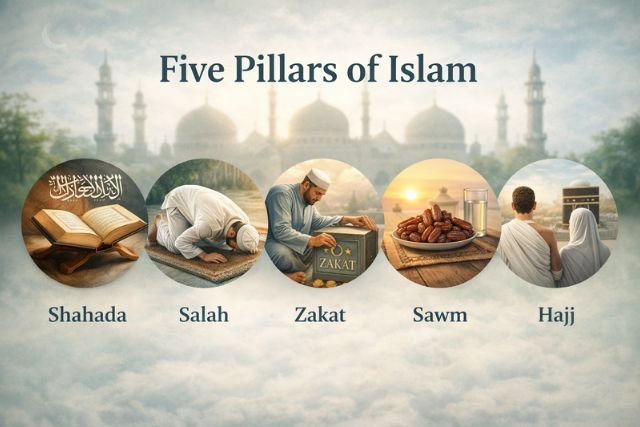
They are:
- Shahada (Faith) — The declaration of belief in Allah and His Messenger.
- Salah (Prayer) — Establishing five daily prayers.
- Zakat (Charity) — Giving a portion of wealth to those in need.
- Sawm (Fasting) — Observing the fast during Ramadan.
- Hajj (Pilgrimage) — Performing pilgrimage to Makkah once in a lifetime, if able.
These pillars are mentioned collectively in a famous Hadith narrated by Ibn ‘Umar (RA):
Islam is built upon five pillars: bearing witness that there is no god but Allah and that Muhammad is the Messenger of Allah, establishing prayer, paying Zakat, fasting in Ramadan, and performing Hajj.
(Sahih al-Bukhari & Muslim)
Each pillar of Islam complements the others; belief gives meaning to prayer, prayer nurtures discipline, charity purifies wealth, fasting builds self-control, and pilgrimage renews unity.
Together, they create a balanced and comprehensive system that transforms belief into action and faith into lifestyle.
1. Shahada – The Declaration of Faith
At the heart of Islam lies the Shahada, the first and most fundamental pillar. It is the declaration that defines a Muslim’s identity:
Ashhadu an la ilaha illa Allah, wa ashhadu anna Muhammadan Rasul Allah. “I bear witness that there is no god but Allah, and I bear witness that Muhammad is the Messenger of Allah.”
It’s not just a sentence, it’s a life-long promise, a spiritual contract between the believer and Allah.
The first half affirms Tawheed (the oneness of Allah), rejecting all false gods or partners. The second half recognizes Prophet Muhammad (PBUH) as the final messenger, whose teachings complete the message of Islam.
The Spiritual Depth of Shahada
When a person sincerely proclaims the Shahada, they enter the fold of Islam. But its meaning goes far beyond words; it must live in the heart and reflect in action.
To truly believe “There is no god but Allah” means to:
- Trust Allah completely, even when things seem uncertain.
- Love what Allah loves, and avoid what displeases Him.
- Let faith guide every decision from worship to work, family, and ethics.
Shahada transforms how you see the world. It frees you from dependence on people, wealth, or status — and centers your life on Allah alone.
So know, [O Muhammad], that there is no deity except Allah and ask forgiveness for your sin and for the believing men and believing women.
(Surah Muhammad 47:19)
Living by the Shahada in Daily Life
Every action in a Muslim’s life is connected to Shahada. Saying Bismillah before starting something, praying on time, speaking truthfully, and helping others all stem from that central belief in Allah.
Even in challenges, Shahada gives strength. When life feels heavy or confusing, simply saying La ilaha illa Allah can steady the heart. It reminds you that hardships always carry meaning and that Allah’s mercy is never far away.
For parents and teachers, teaching Shahada means nurturing belief with love and example. Children learn not only by words, but by seeing sincerity in prayer, kindness in speech, and honesty in actions.
In this way, Shahada becomes not just a declaration but a living light that guides generations.
2. Salah – The Prayer That Strengthens the Soul
Salah (prayer) is the second pillar of Islam, a daily invitation to step away from the noise of life and stand before Allah in peace and focus.
It is not only a ritual but a rhythm that shapes a believer’s entire day.
Muslims pray five times daily: Fajr, Dhuhr, Asr, Maghrib, and Isha. Every prayer gently reminds a believer that faith isn’t tied to one moment. Also, something that stays with you all day — in work, in rest, and in every quiet pause when you remember Allah.
Indeed, prayer prohibits immorality and wrongdoing, and the remembrance of Allah is greater.
(Surah Al-Ankabut 29:45)
Spiritual Purpose of Salah
Every time a Muslim prays, they reaffirm the Shahada, their faith, and submission to Allah. Salah cleanses the heart from arrogance and brings peace to the mind.
Five times a day, the believer:
- Pauses — stepping away from worldly distractions.
- Reflects — remembering Allah’s blessings and guidance.
- Renews — realigning their purpose and actions.
This constant reconnection keeps the soul alive and aware. It strengthens humility, gratitude, and discipline, three qualities that transform not just faith, but character.
Salah in Modern Life
In today’s world, schedules are packed, and distractions are endless, yet prayer provides balance. It brings calm to the restless and strength to the tired.
Even offering Salah at work, in schools, or during travel builds courage and identity. Today, technology makes it easier for Muslims to stay connected to their prayers. There are apps that send gentle reminders for Salah times, digital Qur’an platforms that help with reading, and online classes where you can learn Tajweed or improve your recitation at your own pace.
What matters most is sincerity, not perfection. A single heartfelt prayer is more valuable than countless distracted ones.
The Prophet Muhammad (PBUH) said:
The first matter that the slave will be brought to account for on the Day of Judgment is the prayer. If it is sound, then the rest of his deeds will be sound.
(Sunan al-Tirmidhi)
Salah, therefore, is the believer’s heartbeat when it stops, the soul loses direction.
3. Zakat – Charity That Purifies Wealth and Society
Zakat, the third pillar, teaches Muslims that wealth is not truly ours — it’s a trust from Allah. Giving a portion of it to those in need purifies the heart and blesses what remains.
The Qur’an says:
Take from their wealth a charity by which you purify them and cause them to increase.
(Surah At-Tawbah 9:103)
The Deeper Meaning of Zakat
The word Zakat means “to purify” and “to grow.”
When we give from what we love, Allah multiplies it both in this world and in the Hereafter.
Zakat purifies not only wealth but the soul from greed, selfishness, and attachment to material things.
It reminds every believer that success is not in how much we own, but in how much we share.
Social Impact of Zakat
Zakat works like a bridge between the rich and the poor. It keeps wealth moving through the community so that blessings are shared, not stored — and no one is left hungry or forgotten. It supports:
- The poor and needy
- The indebted
- Travelers in difficulty
- Community welfare and education
Through Zakat, Islam builds compassion, removes envy, and strengthens brotherhood.
Just imagine a place where everyone gives their Zakat with sincerity. Fewer people would struggle, hearts would soften, and kindness would spread naturally across society.
Modern Practice of Zakat
Today, giving Zakat has become easier. Muslims can calculate and pay their dues through Zakat calculators, trusted charities, and community mosques.
But it’s important to remember that Zakat is different from voluntary charity (Sadaqah).
Zakat is an obligation, a spiritual tax that purifies wealth, while Sadaqah is extra giving for Allah’s sake.
When given sincerely, even a small act of Zakat or charity can change lives and earn Allah’s immense reward.
The Prophet (PBUH) said:
Charity does not decrease wealth.
(Sahih Muslim)
4. Sawm – Fasting That Builds Patience and Gratitude
The fourth pillar, Sawm (fasting), is observed during the holy month of Ramadan.
From dawn until sunset, Muslims abstain from food, drink, and physical desires not as punishment, but as purification.
O you who have believed, fasting is prescribed for you as it was prescribed for those before you, that you may become righteous.
(Surah Al-Baqarah 2:183)
Spiritual Purpose of Fasting
Fasting teaches more than hunger. It teaches control, empathy, and awareness of Allah.
When a believer refrains from what is normally allowed, their heart grows stronger against temptation and sin.
It is a personal act of worship hidden between you and Allah where no one can truly see your sincerity but Him.
Emotional and Social Lessons of Fasting
Fasting creates equality.
The rich and poor feel the same hunger, reminding everyone of compassion and gratitude.
Families come together for Iftar, mosques fill for Taraweeh, and the ummah unites in devotion.
During Ramadan, Muslims also learn patience in speech, control in anger, and kindness in actions.
It is a time to forgive, give, and reflect a month of mercy that resets the heart.
Benefits Beyond Ramadan
The discipline of fasting carries over even after Ramadan.
Voluntary fasts such as on Mondays, Thursdays, or the white days (13th–15th of every lunar month) continue the habit of spiritual focus.
Fasting also improves physical health, mental clarity, and emotional strength.
It teaches moderation, gratitude, and appreciation for even the smallest blessings like water after sunset.
5. Hajj – The Journey of Unity and Devotion
The fifth pillar of Islam, Hajj, is more than a pilgrimage, it is a journey of the heart.
It represents submission, humility, and unity. Every year, millions of Muslims from every corner of the world gather in Makkah to perform Hajj, dressed alike, standing shoulder to shoulder before Allah.
And [due] to Allah from the people is a pilgrimage to the House – for whoever is able to find thereto a way.
(Surah Al-Imran 3:97)
Spiritual Lessons from Hajj
Hajj teaches that no matter where we come from or what we own, we are all equal before Allah.
When a believer performs Hajj:
- They leave behind luxury and pride, wearing the same simple white garments as everyone else.
- They walk in the footsteps of Prophet Ibrahim (AS) and his family, reliving their acts of sacrifice and faith.
- They renew their purpose, seeking forgiveness and starting anew.
The emotional experience of standing on Mount Arafah, praying for mercy with millions of believers, is unlike anything else. It symbolizes the Day of Judgment when every soul will stand before Allah, equal and humble.
Practical Impact of Hajj
Not everyone can perform Hajj right away; it requires financial stability and health. But every Muslim can prepare spiritually by learning its meaning, saving gradually, and supporting others who go.
Even those who cannot travel can still gain reward by helping pilgrims, making du’a, and maintaining sincerity in worship during Dhul-Hijjah, the sacred month of Hajj.
The Prophet Muhammad (PBUH) said:
The reward for an accepted Hajj is nothing less than Paradise. (Sahih al-Bukhari & Muslim)
After such a journey, a believer doesn’t simply return home and stop there. The experience changes them; it renews the heart and gives new energy to live with faith and gratitude.
How to Teach the Five Pillars of Islam to Children and New Muslims
The beauty of Islam is that its foundation is simple and universal. The Five Pillars can be understood at any age and by anyone, regardless of background.
Teaching them with love, clarity, and real-life examples makes faith come alive.
For Children
Children learn through observation, repetition, and stories. Instead of abstract lessons, connect the pillars to daily life:
- Shahada: Let them hear it often and understand that it means loving Allah and following His Prophet (PBUH).
- Salah: Encourage praying together as a family, even if they just imitate you at first.
- Zakat: Teach generosity by letting them share toys or food with others.
- Sawm: Let them experience shorter fasts or join family iftars to understand patience.
- Hajj: Show them pictures or documentaries of pilgrims, explaining how Muslims unite in love for Allah.
Using visuals, simple language, and positive reinforcement makes learning about Islam joyful, not strict.
The best among you are those who learn the Qur’an and teach it.
(Sahih al-Bukhari)
For New Muslims
For anyone newly embracing Islam, the Five Pillars are like gentle steps that show where to begin. They make the path to faith easier to follow and help a person grow closer to Allah one small act at a time. Start by focusing on one pillar at a time, understanding its meaning before practicing it.
Encourage them to:
- Join local study groups or online classes, such as Learn Al Qur’an Academy.
- Connect with supportive Muslim communities.
- * Learn gradually, and sincerity matters more than speed.
Patience and guidance make faith grow strong. Some new Muslims often notice that peace comes when they move slowly. Maybe it begins with one quiet prayer a day, or just sharing a little of what you have with someone in need. Those small things might not look big, but over time, they build faith, calm, and real trust in Allah.
Importance of the Five Pillars of Islam in Building a Peaceful Life and Society
The Five Pillars are not just personal acts, they are a system that transforms both individuals and communities.
1. Personal Transformation
They teach faith, discipline, humility, and gratitude. A believer who prays, gives, fasts, and serves lives with purpose and inner peace.
Faith becomes a source of strength, guiding every emotion and decision.
2. Family Harmony
When practiced as a family, the pillars create unity, love, and shared values.
Children grow up seeing Islam not as rules, but as a way of life filled with mercy and balance.
3. Social Justice
Zakat and Sawm build empathy. They close the gap between rich and poor, making communities stronger and more compassionate.
4. Global Unity
Hajj symbolizes the equality of all believers regardless of race, language, or wealth.
It reminds us that Islam unites hearts beyond borders.
When people truly live by the Five Pillars, their faith shows in everyday life. It builds communities where fairness matters, where people care for each other, and where the spirit of Islam can be felt in kindness and peace.
Conclusion
The Five Pillars of Islam are more than duties to complete. They form the base of a believer’s faith, shaping a life filled with purpose, peace, and direction. Each one connects the heart to Allah and teaches how to live with balance and compassion.
Each pillar carries a message:
- Shahada teaches belief.
- Salah builds discipline.
- Zakat cultivates generosity.
- Sawm develops self-control.
- Hajj nurtures unity.
Together, they remind every believer that Islam is a balance between devotion to Allah and service to humanity.
Living by these pillars makes faith visible — in prayer, in kindness, and in the way Muslims treat one another. The Qur’an reminds believers that Allah guides those who hold firmly to what is right. As Muslims try to follow that guidance, we ask Allah to keep our hearts firm and our worship genuine. We also pray that He brings people together in peace and understanding.
Copyright 2025. learnalquran. All Rights reserved.